Thanks for shopping small & local!
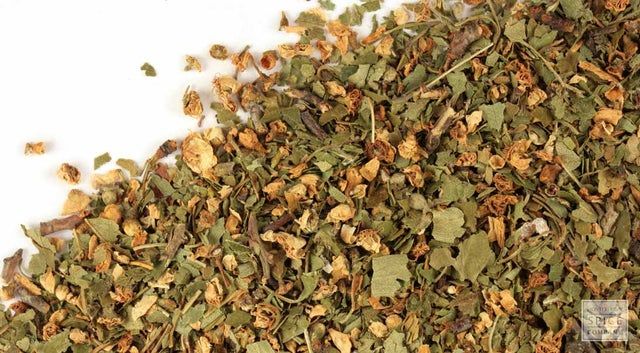
Hawthorn Leaves & Flowers
Share
$3.08
Sold out
Sold out
Hawthorn Leaves & Flowers
Share
Customer reviews
Customer reviews
Reviews only from verified customers
No reviews yet. You can buy this product and be the first to leave a review.
Product details
Crataegus monogyna is a large shrub native to Europe and a member of the Rosaceae family. Hawthorn flowers bloom around the first of May and have traditionally signified the first days of summer. Sprigs of hawthorn were incorporated into the Beltane festivals of ancient Europe celebrating this time of the year. Hawthorn leaf and hawthorn flower can be employed in much the same way as the berries and hold many similar beneficial properties. Also spelled, hawthorne, the leaf and flower can be steeped as hawthorn tea, added to cordials, or tinctured. Hawthorn leaf, flower, and berry have been praised over the centuries for their heart elevating properties. Believed to uplift and strengthen both the physical and emotional heart, hawthorn, as it supports healthy cardiovascular function, was also revered for ceremonial and spiritual purposes. The flavorful red berries have been used in candies, jams, jellies, wines, and cordials and are widely available in many forms as dietary supplements. Hawthorn supports healthy circulation and cardiovascular functioning.* Crataegus is a thorny shrub or tree with stems and trunks that consist of hard wood and gray bark, often having tri-lobed leaves and white flowers that are similar to other genera in the Rosaceae family and bearing bright red berries. There are around 280 known species, several of which are used in traditional medicine and may be used interchangeably. Generally, C. laevigata (synonym C. oxyacantha) and C. monogyna are found in commerce. In Traditional Chinese Medicine (TCM), C. pinnatifida is used. Crataegus oxyacantha is derived from the Greek 'kratos', meaning hardness and referring to the wood, 'oxcus' which means 'sharp', and 'akantha' which is a thorn. In several countries in Europe, in particularly Germany, the hawthorn was used as a hedgerow, 'haw' being an older term for 'hedge.' This shrub was also referred to as 'whitethorn' due to its light bark. C. mongyna or English hawthorn is native to the northern temperate forests of Europe and has become widely naturalized in the United States. Most hawthorn that is cultivated for commercial purposes is obtained from the United Kingdom and other countries such as Albania, Bulgaria, Romania, the former Yugoslavia, and Poland. Collect the flowering branches in the spring as all parts (leaves, twigs, spines, flowers) may be used for fresh tincturing. Or if drying, discard stems and spines. The berries are best harvested in the fall when they are fully ripe, and before the first frost. Hawthorn has been used since the Middle ages, with some accounts going back as far as the first century to Greek herbalist Dioscorides. It was later used by Swiss physician Paracelsus (1493–1541 CE). Considered to be a particularly symbolic tree with many folktales and magical myths surrounding it, hawthorn was "sacred tree medicine" to the ancient Druids, and was said to house fairies, specifically when growing with oak and ash trees. However, it was unlucky to bring the flowers into the house, quite possibly because they would bring the fairy folk with them. Hawthorn twigs and flowers were incorporated in the marriage wreath symbolizing chastity and insuring prosperity at Greek weddings and were also used to decorate alters worshipping the goddess of marriage, Hymen. In Ireland, couples desiring hawthorn's blessing would dance around it at marriage ceremonies. The sprigs were attached to newborn's cradles to protect them from evil and also used to decorate the maypole for the May Day or Beltane ceremony, which celebrated fertility and renewal. The blooming of this tree coincided with the first day of summer which occurred in May. In the traditional medicine of Europe all parts of the tree were appreciated and utilized: leaves, berries, flowers, and the wood. The blossoms were used as a heart tonic and a diuretic, and the berries and leaves were made into an astringent tea to soothe throats. The bright red sumptuous berries were also made into a tasty brandy cordial.
See our Tea Brewing Instructions
Pricing for herbs, powders, teas, salts & herbal blends is per ounce unless otherwise specified.
This information is for education purposes, and is not intended to diagnose, treat, cure, or prevent any disease. This information has not been evaluated by the Food and Drug Administration.
Powered by Lightspeed
Display prices in:USD